The 2019 building code and the 2020s three-flat boom
Last month, I wrote about how the 2019 Chicago building code combined with a series of parking reforms to create a new multifamily infill typology: the III-5, or five-story buildings newly eligible to be built using "Type III" construction.
But I also noted that the 2019 code led to a substantial change in another type of housing: Three-story buildings.
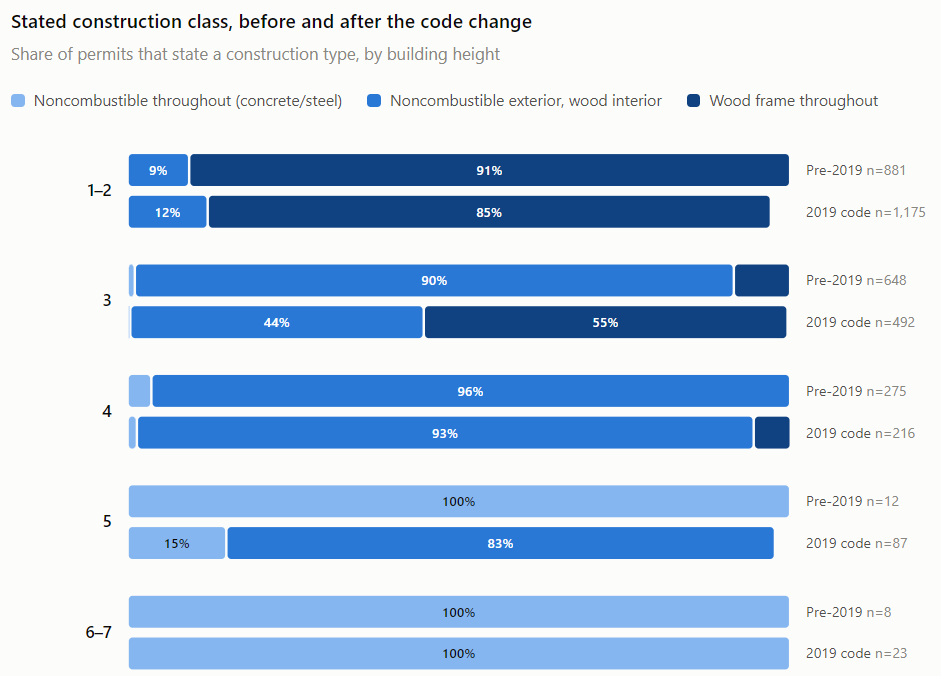
Just as the 2019 code allowed five-story buildings to shift from the most-expensive Type V construction to the less-expensive Type III, it allowed three-story buildings to shift from Type III to the even-cheaper Type I. (A reminder: Type V is all "noncombustible," or brick, concrete, and steel; Type III has a noncombustible outer shell with wood frame interiors; and Type I is entirely wood.)
Unlike with five-story buildings, which were required to be Type V prior to the 2019 code, three-story buildings were allowed to be Type I—but with several limitations, especially with respect to the floor area of the top story. As a result, nine out of ten three-story residential buildings were built as Type III before the 2019 code.
The 2019 code removed these fetters, and the share of three-story residential buildings built as Type III has dropped by more than half since then, while 55% of new three-story residential buildings have been built as Type I. Indeed, in recent years the split has been even more lopsided:
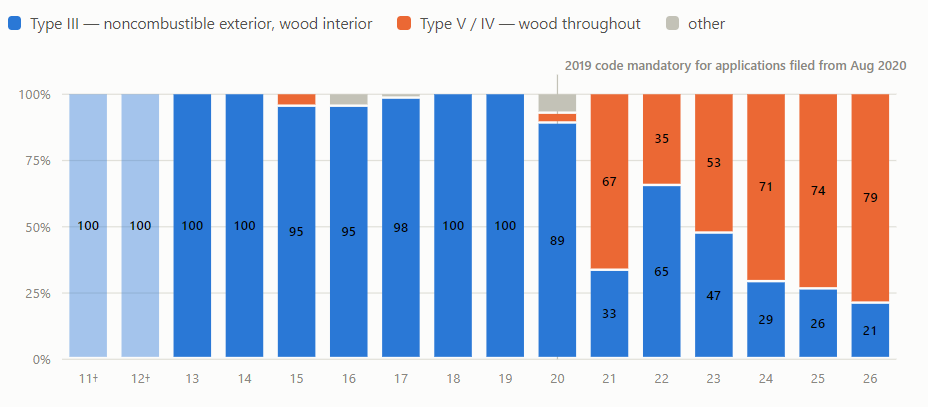
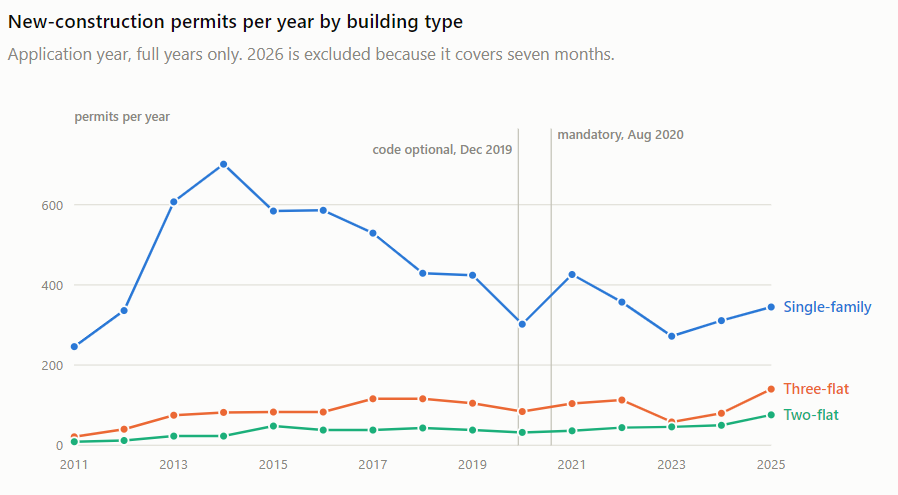
In the III-5 case, there is not just a shift in the composition of new five-story buildings—there's a big uptick in the number of five-story buildings built. Did opening the door to Type I (read: cheaper-to-build) three-story buildings lead to a notable uptick in housing typologies facilitated by that size? In particular, did it lead to more two- and three-flats, rather than single-familiy homes?
(There's a whole sub-essay to be written about the relationship between a three-story building and a three-flat, but I'm not going to write it. I'll just note that I am sliding between these two things, because I'm interested primarily in how this building code change affected the "2-4" housing stock. Note that three-story buildings also facilitate two-flats, because they allow for two stacked duplexes: One on the upper two floors, and one on the first floor and garden level. Indeed, this allows for two three- or four-bedroom units, which as condos are extremely valuable.)
Well, not nearly as notably:
But if you normalize by the pre-Covid baseline, things look slightly more suggestive:
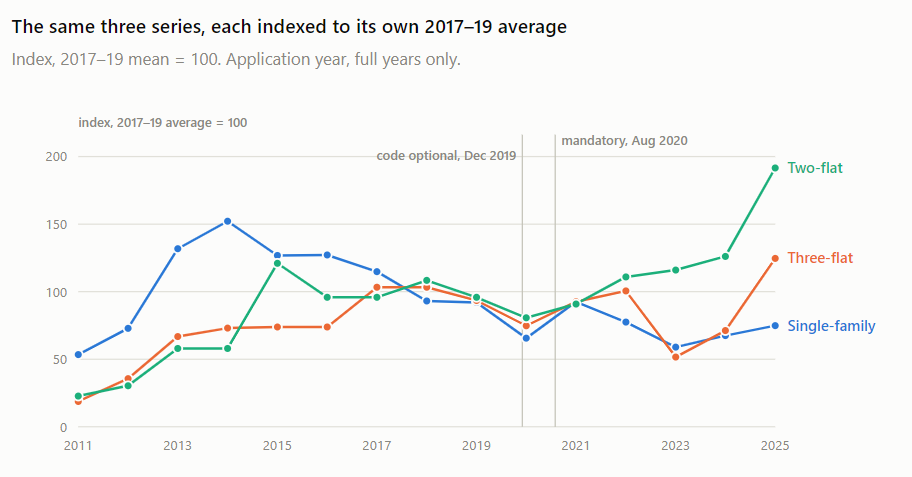
Not nearly as convincing as the five-story building permits, but enough to scratch your chin about.
Then again, when it came to the five-story buildings, decomposing permits by the zoning code in which they were built was informative. What if we do that here? Nearly all 1-3 unit buildings are built in one of three zoning categories: RS, which usually allows only single-family homes but sometimes allows two-flats; RT, which allows three-flats; and RM, which allows larger multifamily buildings.
So what if we only look at three-flats in RT and RM zones, where they're actually allowed?
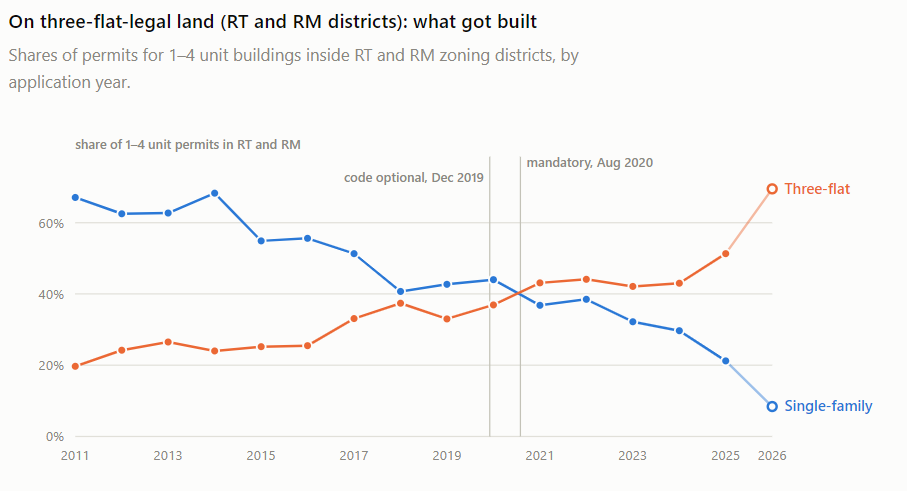
Now we're getting somewhere! The 2020s have seen a complete inversion of the 2010s dynamic in residentially zoned land that allows multifamily by right: From more than a 3:1 ratio of single-family homes to three-flats to a more than 7:1 ratio of three-flats to single-family homes by 2026. When we look at the data overall, this dynamic is somewhat hidden by the fact that far more land is zoned RS, where three-flats can't be built no matter what the building code says.
Notably, the beginnings of this shift predate the 2019 code; it's certainly visible at least by 2017. Nor is there an immediate shift after the adoption of the 2019 code in 2020. Instead, we see a growing gap really take off starting around 2023-2024. So while this is a very striking finding, it's not clear how much of it has to do with the 2019 code.
But in some ways, the more interesting shifts—and more convincingly code-related—were geographic. Here are a set of maps and a table comparing the six years prior to the enactment of the 2019 code to the six years following.
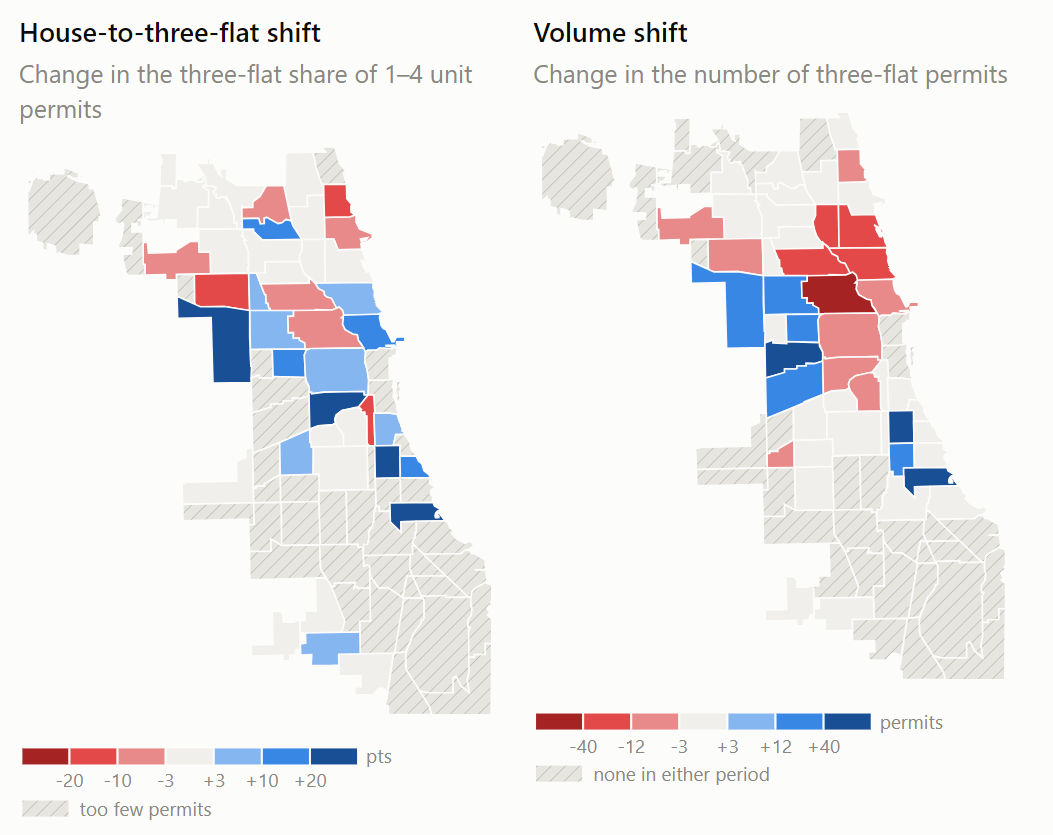
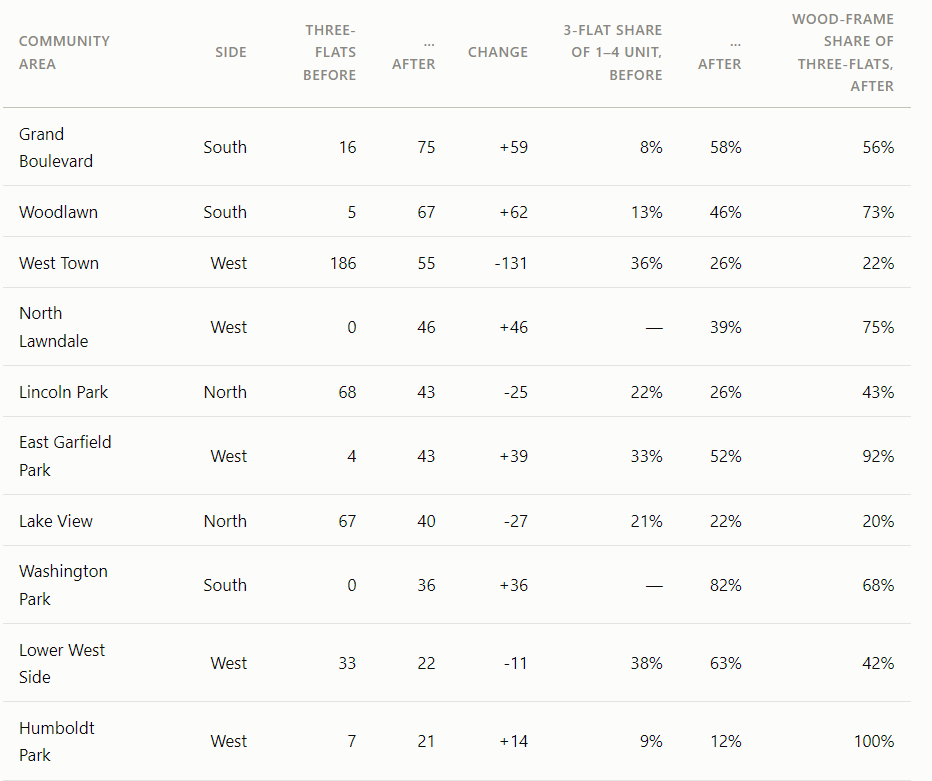
The adoption of the 2019 code was associated with a massive shift in three-flat construction to South and West Side communities. The number of three flats built in Grand Boulevard increased more than fourfold; tenfold or more in East Garfield Park and Woodlawn; and from literally zero to dozens in Washington Park. (North Lawndale also experienced this, though I believe a meaningful number of these are City-subsidized, rather than market-driven, making the cost impacts of building code changes different.) At the same time, building fell in places like Lakeview and West Town.
Even more suggestive is that the share of three-flats that are built as Type V varies substantially, and in exactly the way you would suspect: Three-flats in lower-cost neighborhoods are much more likely to be built in all wood (73% in Woodlawn, 92% in Washington Park) versus higher-cost neighborhoods (22% in Lincoln Park, 20% in Lakeview).
In other words, creating a lower-cost way to build three-flats seems to have induced developers to build more three-flats in places where—perhaps—market prices would not be able to cover the cost of masonry construction.
(A separate question is: Why did 1-4 construction overall fall so much on the North Side in the 2020s? I have no idea. But floating over all of this, of course, is the market effects of Covid. That is outside the scope of this post, except for me to gesture at and invite you to make your own hypotheses.)