Losing Chicago's edge

Every six months or so it seems that there is a round of discourse on the discourse sites (Twitter/X is how I am exposed to it most of the time) about why Chicago isn't...better, or something. Or not better, almost the reverse: Why is Chicago so good (big, dense, amenity-rich, relatively transit-friendly, etc--the things that someone sitting in New York might think makes for a "real" city) and yet so irrelevant, as measured by whether people who consider themselves in the inner circle of what matters think about it very much.

There are entire book-length treatments on some aspects of this around cultural production. I don't think I'm especially qualified to opine about it, so I won't.
But one little thread of this discourse is a bit more tractable, which is the question of Chicago's relevance vis a vis domestic migration—that is, do people in unquestionably "relevant" places consider Chicago a good place to move?
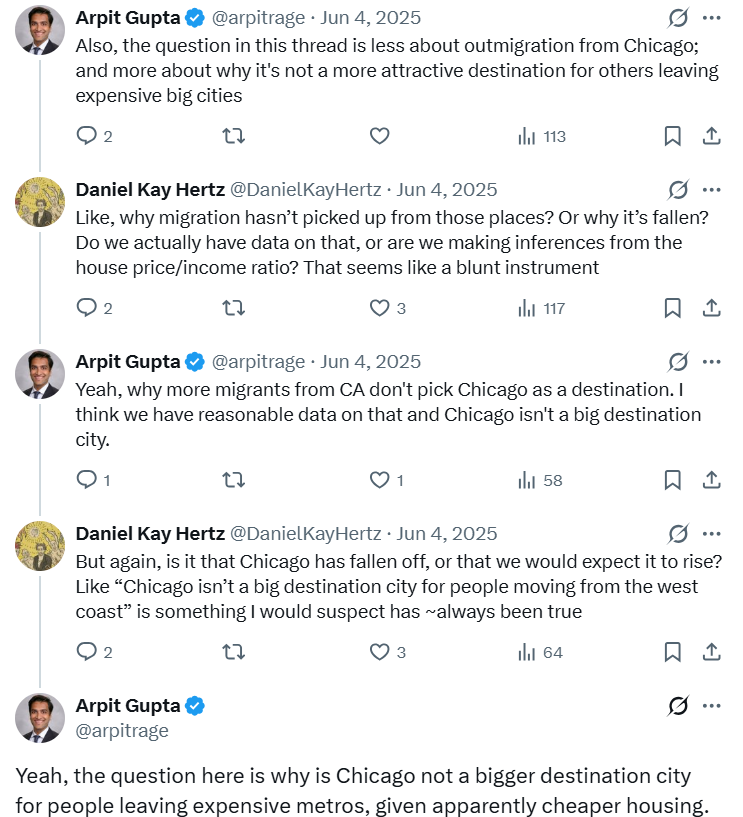
My curiosity here is less about why and more about whether: Is it in fact the case that Chicago a) is not a destination city for people leaving expensive parts of the country, and b) that this is increasingly the case—that there is a story of decline here?
Fortunately, there is some blunt instrument data that can shed light on this question. The Census measures the flows of people from county to county, so we can ask how those flows from high-cost states to Chicago (Cook County) look like over time, and compared to other cities.
One-year inflows from four high-cost states (CA, NY, MA, WA)
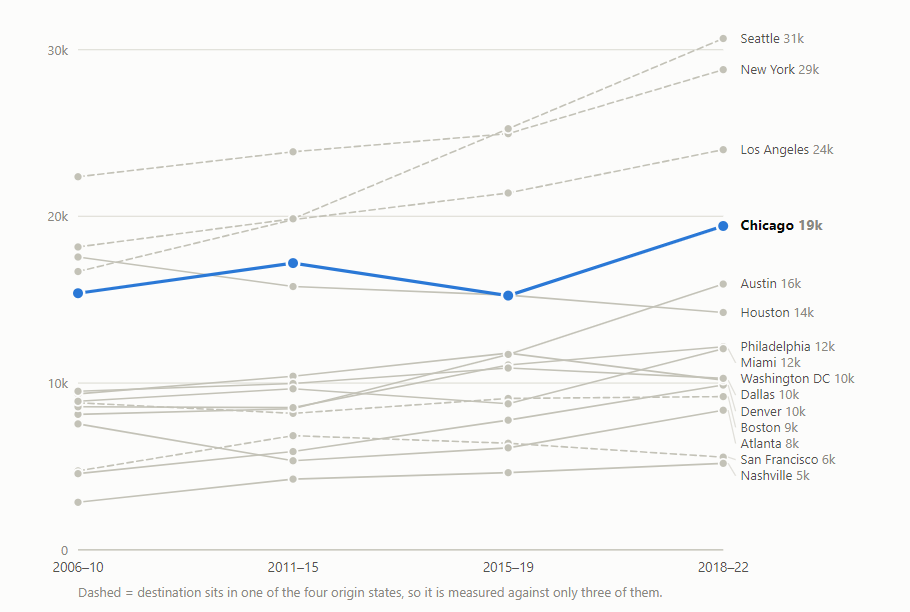
Here are absolute number of in-movers to a variety of cities from four high-cost coastal states: California, New York, Massachussetts, and Washington. (Cities that are located in one of these states are counted against only the other three.) Chicago seems to do okay:
- More people from these high-cost states move to Chicago (Cook County) than to Houston, Dallas, Miami, Austin, or Nashville—the big Texas contenders for Chicago's position as third city and the It cities of the 2020s. In most cases, the gap is wide: Nearly twice Dallas and four times more than Nashville.
- Chicago's pull from these states is higher in the early 2020s than at any point since the Great Recession; total inflows are up more than 20% over this period.
Then again, Chicago is a larger city than all of those places and much larger than several of them. What happens if we look at this on a per capita basis?
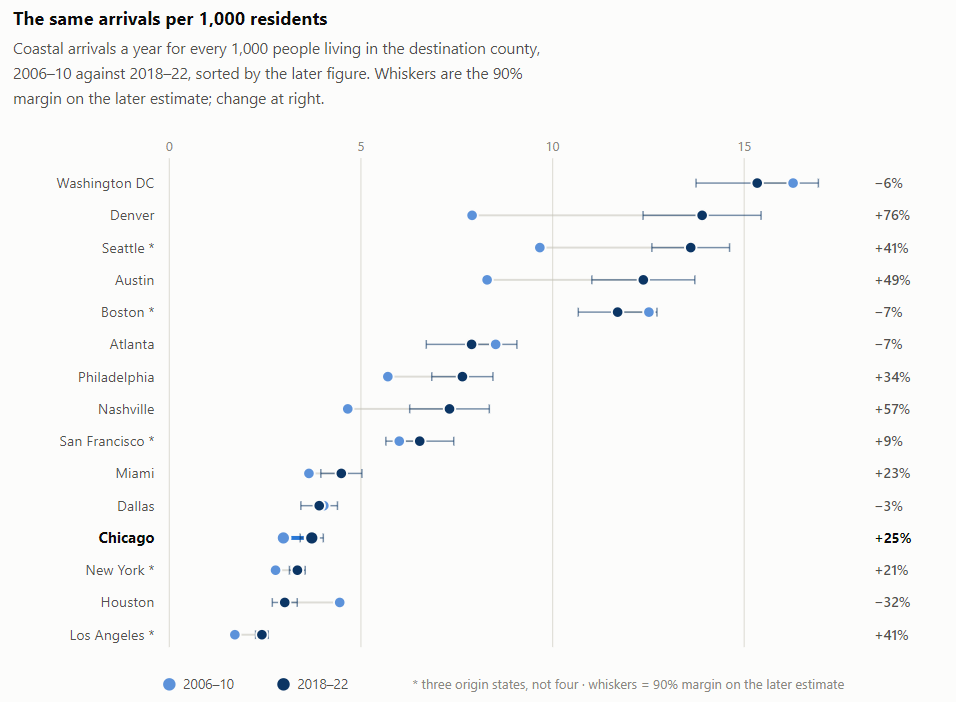
In this version, Chicago is much less impressive. Indeed, it drops to second-to-last of the non-coastal cities included in the list, ahead of only Houston in the 2018-22 period.
(One note: Readers may be asking themselves what work the choice to look at core counties, rather than entire metropolitan areas, is doing here. I won't reproduce the entire robustness check but suffice it to say that while the switch from core county to metro rejiggers a lot of the non-Chicago cities' numbers, it does not affect Chicago's ranking. It does, however, close some of the gap between Chicago and other places. But even that is hard to know how to interpret: On the one hand, we might say that the metro area is the "true" economic region, and therefore the chart above makes Chicago look worse than it really is. On the other, we might say that disproportionate in-migration to core counties represents a strength of other core cities, and Chicago the municipality looks relatively weak compared to its suburbs. On a third hand, this might all be down to arbitrary aerial units: The greatest gap between core county and metro numbers is in DC, which also happens to have a core "county" that is an extremely tiny portion of its region, as opposed to Cook County, which is more than half of the Chicago metro area's population. Would Chicago show a bigger gap if its core county were the 600,000 people closest to the Loop?)
Okay, one more thing.
Share of all domestic in-movers who are from CA, NY, MA, or WA
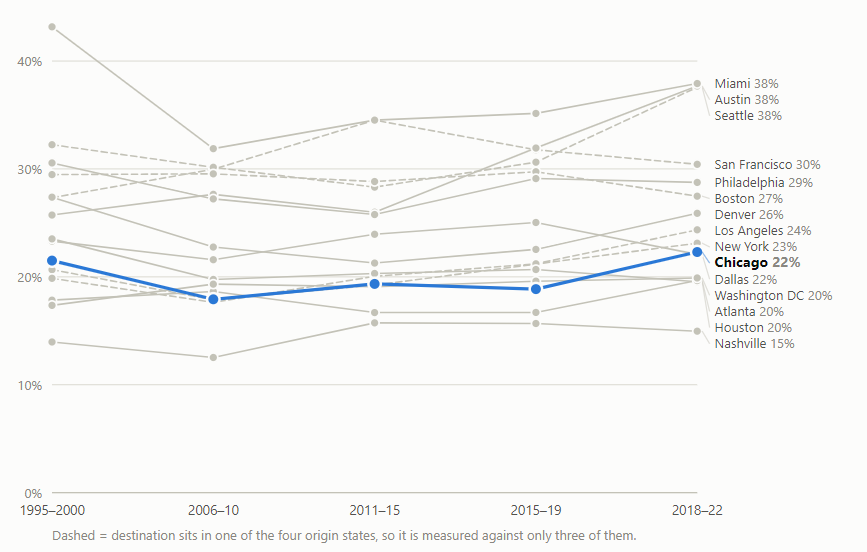
Another way of normalizing this data isn't against a city's total population, but against its total population of in-movers. In other words: Are the people who move to a given place especially likely to be from high-cost coastal states?
This is a meaningfully different chart. Most cities are clustered at between 20-30% of their domestic in-movers being from one of the four high-cost coastal states; if you remove cities that are in one of those states and Philadelphia (on the grounds that it is extremely close to New York), then you get six of nine remaining cities clustered between 20-26%, including Chicago.
Three cities remain as outliers: Miami and Austin on the high end, at 38%, and Nashville at the low end, at 15%. One way of thinking about this is that Miami and Austin are uniquely attractive as moving destinations specifically for residents of high-cost states, and not for other Americans. Intuitively, this makes some amount of sense: Both Austin and Miami became known in the 2020s as kinds of ports of refuge for blue state expats—California tech workers in particular for Austin, and a range of the wealthy and put-upon for Miami. Nashville is a bit of a surprise in the other direction, although I suppose if you wanted to be obnoxious about it you could fit it into a narrative of Nashville as a kind of capital of "America B."